Hitchcock was no stranger to how to frame a camera shot, but when it came to the female role, its slim pickings....
The term 'gender' can be defined as "all of the socially defined, learned, or constructed accouterments of sex." (Lippa, 2002) Hithcock developed most of his films in the 1950's where the gender roles of the man and the women were status quo. The women lived as the american suburban housewife, kissing their husbands on the cheek as they go off to work, and cooking and keeping the house up to their man's standards. Little ambition was to be expected from these housewives; only men were allowed to make the changes and make the decisions in the family. The following page developed the case that gender is constructed through social factors.
The 1950's where a time of change for the modern household. The first mass-produced suburb was built in 1951, making it very easy for young couples to buy a home. The "baby boom" along with new forms of entertainment (such as television) stimulated a "consumer culture" which pressured families to compete with the perfect image of a family. This image consisted of a white suburban frame with gender specific roles. Entertainment and culture created a generation that made the feminine fulfillment the center of contemporary culture. In other words, media was the driving force behind the "feminine monster" (Freidman, 1963).
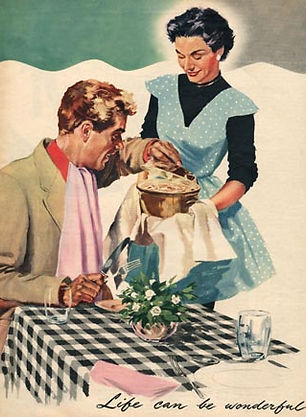
Perfect Wives In Ideal Homes, 2015

In Betty Freidman's study The Feminine Mystique, she was the pioneer of identifying the stereotype of the "ideal women." She stated the feminine mystique
held that women could fine fulfillment only in sexual passivity, male, domination, and nurturing maternal love. It denied women a career or any commitment outside the home and narrowed woman's world down to the home, cut her role back to housewife (Friedan, 1963).
Perfect Wives In Ideal Homes, 2015
Courtney and Lockeretz were at the forefront of researching the "ideal" women of the 1950's. Their studies included the different roles women play in the household and which products were associated with them in advertisements. Their research found that most women were advertised in "nonworking roles in the home." Non working roles include washing the dishes, child care, laundry, and cleaning. Studies also showed that women were more likely to use food, clothing, and cosmetic products while men were shown to purchase more expensive items/ investments such as land, cars, stocks and bonds.

Family Circle, 1956

The concept of physical beauty and attraction holds a tight grip over men to this day. It was no different in the 1950's either. Men define women by their sexual attraction, seeing them as objects. Which, in turn, lowers their status to something of a possession. This idea men held propelled the advertising and media industry to gear their content to pleasing the man (Courtney and Lockeretz, 1967).
Better Homes & Gardens, 1956

This article came from an magazine issue called Housekeeping Monthly in May of 1955. Explaining certain aspects of what make a wife good.
Society as a whole has motivated both genders to distance themselves from each other. Where males are aggressive and hostile to others and given little to no consequences while females are not supposed to partake in male activities and become a supporting tool to their male counterpart (Lippa, 2002).