
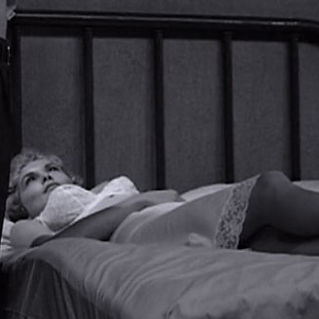
The "Male Gaze"
This term was created by Laura Mulvey who was an early birtish film theorist. This term involves the way of seeing women and the world. This psychology behind the 'male gaze' is closely tied to scopophilia; which is the pleasure of looking.
A lot of Hitchcock's films have been central to developing a feminist film theory as well as the practice of film criticism. Laura Mulvey's essay, "Visual Pleasure and Narrative Cinema," focus on Hitchcock films and how they are passive objects for male fantasies. The look, is the crux of Rear Window where Lisa is victim to Hitchock's use of camera angles. Hitchcock also favors the male protagonists view in Rear Window, which allowed the viewers to share the "uneasy gaze". Hitchcock has us believe that the audience is the protagonist; experiencing all features and angles of Lisa. The only difference here is that while the audience hold sexual interest in Lisa, Jeff sees her merely as a bystander to his makeshift investigation. (Mulvey, 67). In the page "Rear Window", there are numerous scenes that involved the "male gaze" along with common traits the ideal 1950's women would hold.
Tania Modleski states in "remastering the Master"Hitchcock after Feminism" that Lisa is more threatening and intimidating to the male protagonist due to her physical beauty and status outside of the apartment. This is only familiar in one other Hitchcock film such as Rebecca, where the story was driven by a past lover who shared no screen time, and how Mrs. De Winter kept feeling insignificant by Mr. De Winter and his maid. This reflects the idea that neither Hitchcock is a misogynist nor he is a type of feminist, rather, his work shows mixed thoughts and feelings about women (Modleski, 2005).